


29 Nov
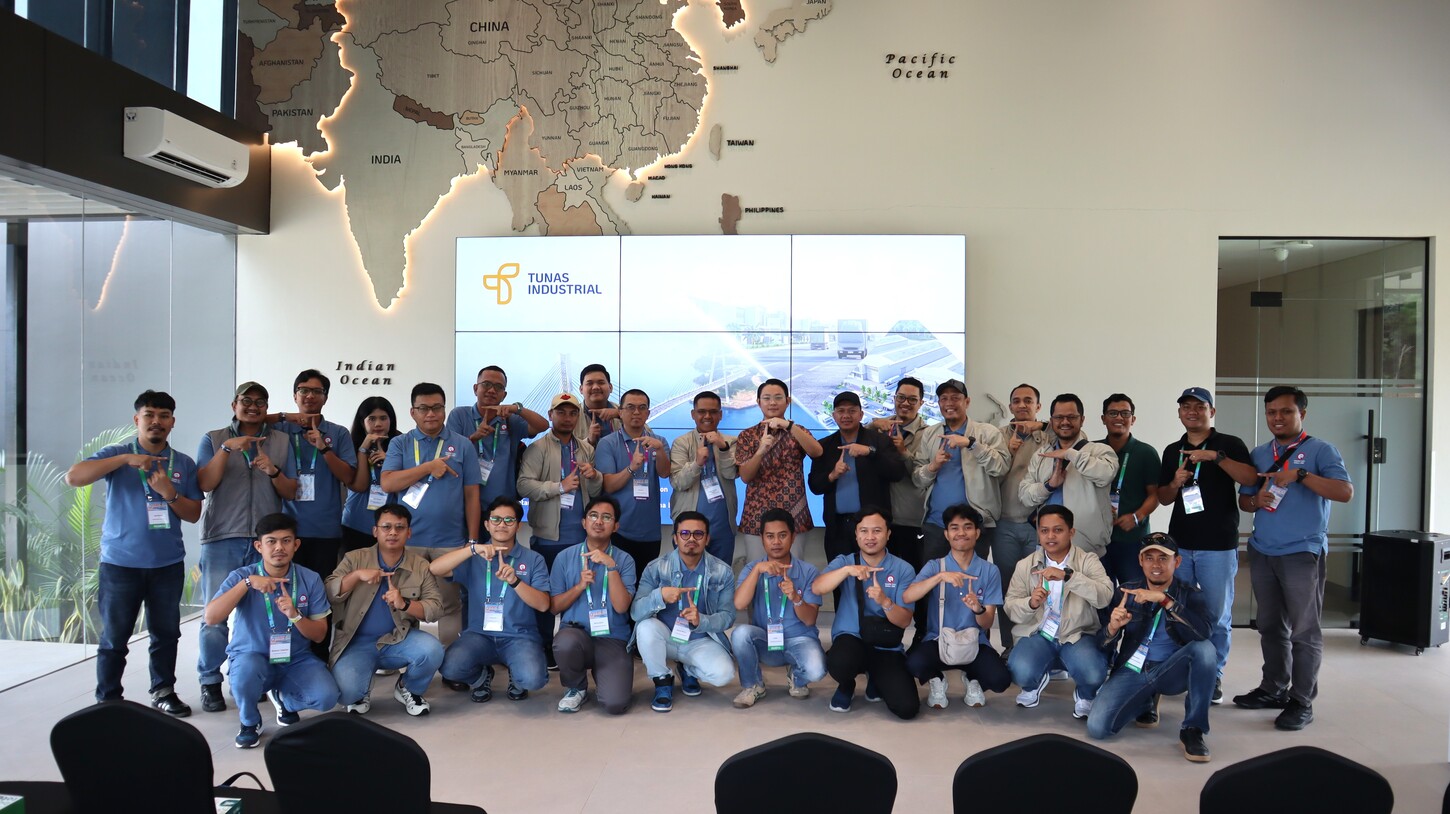
TKMPN 2025 Delegation Visits Tunas Prima Industrial Estate
Batam, 28 November 2025 – Tunas Prima Industrial Estate today welcomed the official delegation of the National Quality and Productivity Convention (TKMPN) XXIX 2025, an annual national platform where Indonesian organizations showcase their innovations and achievements in quality and productivity enhancement.
Held in Batam from 24–28 November 2025, TKMPN once again entrusted the city as host for the fourth time. This year’s theme, “Strengthening National Competitiveness Through Productive and Sustainable Innovation,” brought together participants from multinational companies, state-owned enterprises, private corporations, government institutions, universities, healthcare organizations, and non-profit institutions.
As part of the industrial visit agenda, Tunas Prima Industrial Estate was selected as a strategic destination for participants to observe Batam’s industrial ecosystem and understand how the estate supports national productivity goals—especially through its sustainability-driven development approach. A total of 28 participants joined the on-site discussion and presentation.
Innovation & Estate Governance at Tunas Prima Industrial Estate
During the Focus Group Discussion (FGD), Chrispin Andereas, Head of Business Development at Tunas Industrial, presented the estate’s strategic initiatives and addressed key questions on operations, sustainability, and Tunas Prima’s readiness to meet future industrial demands.
1. Waste Management
Participants highlighted Batam’s waste challenge, with the city generating 1,300 tons of waste per day (DLH Batam, 2023) and landfill capacity projected to last only until 2030. To address this:
- Tunas Prima is the pioneering industrial estate in Batam to initiate a centralized Industrial Waste Management program.
- The program is built on four pillars: technology innovation, source-based segregation, centralized control, and converting waste into value.
- Waste is managed under an organic–inorganic–economic framework, with 50% recycled through a Materials Recovery Facility (MRF).
These efforts align with Batam City’s long-term plan for a more modern and sustainable waste management system.
2. Clean Water & Wastewater Management
To ensure sustainable water availability:
- Tunas Prima partners with SPAM Batam as the main clean water supplier.
- The estate applies Reduce, Reuse, Recycle principles through:
- WELS 3-ticks certified sanitary fixtures
- A Rainwater Harvesting Pond as an alternative water source
- Wastewater treatment via a Wastewater Treatment Plant (WWTP) before discharge
3. ISO Implementation
Tunas Prima is currently undergoing the audit phase for ISO 9001 implementation, reinforcing its commitment to operational quality.
4. Mobility & Internal Transportation
Tunas Prima is designed as a pedestrian-friendly estate with safe and comfortable pathways within a 1 km radius from the main entrance to offices and warehouses. Pick-up points for taxis and online ride-hailing services will be available at the front entrance. Vehicle restrictions are enforced to maintain safety and order within the estate.
5. Innovation & Green Infrastructure
Tunas Prima is the first green industrial estate in Batam to receive the Green Mark Provisional Certificate from BCA International, supporting its vision of a low-carbon industrial zone through:
- An IoT-based Command Center for environmental monitoring
- Interconnected walkways and bicycle-friendly paths
- Drought-resistant landscape planting
- Energy efficiency and optimized resource use
- Eco-friendly landscape design with future expansion zones
Batam’s strategic position in the Singapore–Malaysia Golden Triangle further strengthens Tunas Prima’s role as a global industrial hub and a preferred destination for modern supply chain activities.
The TKMPN 2025 visit reaffirms Tunas Prima Industrial Estate’s position as a progressive, adaptive, and sustainability-driven industrial area. With modern governance and green infrastructure, Tunas Prima continues to support national efforts to enhance quality, productivity, and competitiveness.

20 Nov
Indonesia Business Registry Guide for Foreign Investors (Part 2)
Choosing the Right Business Entity in Indonesia
Selecting the right business entity is one of the most important strategic steps for foreign investors entering Indonesia. The choice determines your ownership structure, tax exposure, licensing eligibility, and long-term scalability. Under Law No. 40/2007 and the Omnibus Law (Law No. 11/2020), foreign ownership, capital requirements, and business classifications must follow strict regulatory guidelines. Making the wrong choice can cause rejected applications, licensing delays, or even financial penalties. BKPM reported that in 2023, nearly 15% of foreign applicants faced setbacks simply because they registered under the wrong entity type. Choosing correctly is not a formality—it protects your investment.
PT PMA: The Primary Vehicle for Foreign Investors
A PT PMA (Perseroan Terbatas Penanaman Modal Asing) is the standard structure for foreign-owned companies in Indonesia. Under the Positive Investment List (Presidential Regulation No. 10/2021), most sectors allow up to 100% foreign ownership, with restrictions only for sensitive industries.
Key Requirements
-
Minimum total investment: IDR 10 billion per KBLI (≈ USD 650,000)
-
Paid-up capital: At least IDR 2.5 billion (≈ USD 160,000)
-
Corporate structure: Minimum 2 shareholders, 1 director, 1 commissioner
According to the Ministry of Investment, over 70% of new FDI approvals in 2023 were PT PMAs. For investors entering Batam, the PT PMA is even more attractive because it qualifies for special tax, customs, and FTZ incentives managed by BP Batam.
Representative Offices: A Low-Risk Market Entry
If your goal is to study the market, build networks, or coordinate with headquarters—without conducting commercial activities—a Representative Office (KPPA/KP3A) is a cost-efficient option.
Advantages
-
100% foreign ownership allowed
-
No capital requirement
-
Faster, simpler licensing via OSS RBA
Limitations
-
Cannot generate revenue
-
Cannot sign commercial contracts or issue invoices
-
License validity limited to 5 years (renewable)
Representative offices account for around 8% of foreign entries each year, typically for consulting, research, and trading support functions.
Comparison of Business Entities in Indonesia
| Business Entity | Ownership | Capital Requirement | Allowed Activities | Best For |
|---|---|---|---|---|
| PT PMA | Up to 100% foreign ownership (sector-dependent) | IDR 10B investment, IDR 2.5B paid-up | Full operations, contracts, revenue | Medium–large foreign investors |
| Local PT | 100% local shareholders only | From ~IDR 50M | Full operations, but no foreign ownership | Domestic SMEs (not for foreigners) |
| Representative Office (KPPA/KP3A) | 100% foreign (non-revenue) | None | Liaison, research, promotion (no sales) | Market testing / soft entry |
| Branch Office | Not applicable | N/A | N/A | Not available under Indonesian law |
This comparison illustrates why PT PMA is the gold standard for foreign investors intending to operate long-term in Indonesia.
Why Entity Choice Matters More in Batam
Batam’s status as a Free Trade Zone (FTZ) and its strategic location next to Singapore make entity selection crucial. The region attracted USD 1.3 billion in FDI in 2023, driven by manufacturing, shipbuilding, logistics, and electronics.
Choosing the wrong entity can result in lost tax benefits and customs exemptions—especially in Batam’s industrial zones.
Examples
-
A PT PMA in Batam can import raw materials tax-free, use bonded facilities, and re-export finished goods without VAT.
-
A Representative Office receives none of these benefits because it cannot conduct commercial activities.
The distinction directly affects profitability, making entity choice not just a legal issue, but a competitive advantage.
Compliance & Risk: What Investors Must Prepare For
After selecting the correct entity, ongoing compliance is critical. Investors must align with:
-
Tax obligations under the Directorate General of Taxes
-
Expatriate employment rules (Minister of Manpower Regulation No. 8/2021)
-
Environmental and operational permits depending on industry
-
KBLI alignment between registered activities and actual operations
In 2023, 12% of PT PMAs received compliance warnings for KBLI mismatches—an avoidable risk with proper planning.
The Strategic Path Forward
To operate confidently and efficiently in Indonesia:
-
Select the right entity (PT PMA for most foreign investors).
-
Register via OSS RBA to obtain a NIB and required sectoral licenses.
-
Leverage Batam’s FTZ and SEZ incentives where applicable.
-
Maintain compliance through accurate reporting and documentation.
By treating entity selection as a strategic investment decision—not a bureaucratic hurdle—foreign investors can secure long-term stability, maximize incentives, and ensure smooth operations in Indonesia.

17 Nov
Indonesia Business Registry Guide for Foreign Investors (Part 1)
Batam, November 17, 2025 — Entering Indonesia without proper business registration is like building on sand—there is no legal foundation to stand on. Under Indonesian law, every business must be formally registered and licensed through the Business Identification Number (Nomor Induk Berusaha / NIB), as mandated by Government Regulation No. 5/2021 on Risk-Based Licensing.
Once registered, a company gains full legal capability: entering contracts, opening bank accounts, hiring employees, protecting IP, and accessing Indonesian courts. For foreign investors, this is both protection and market credibility—especially in a region where regulatory certainty drives decision-making. Global trends such as China+1 diversification, the restructuring of supply chains, and ASEAN’s rapid economic growth are pushing companies to seek stable bases in Southeast Asia, and Indonesia is emerging as a key destination.
OSS RBA: Indonesia’s Modernized Licensing System
Indonesia’s licensing reforms through the Online Single Submission – Risk-Based Approach (OSS RBA) have significantly improved ease of doing business. The system calibrates requirements based on business risk and has shortened company establishment from nearly 50 days to as fast as 14 days. For international businesses, this modernization means predictable entry timelines, transparent checklists, and a single digital interface.
PT PMA: The Primary Vehicle for Foreign Ownership
For foreign investors, the most important entity is the PT PMA (Perseroan Terbatas Penanaman Modal Asing)—a limited liability company with foreign ownership. A PT PMA allows foreign individuals or corporations to hold up to 100% ownership in sectors open under the Positive Investment List (Presidential Regulation No. 10/2021) (Government of Indonesia, 2021). However, some industries remain partially restricted, requiring local partners. The table below shows a simplified comparison:
| Business Entity | Ownership | Capital Requirement | Best For |
| PT PMA | Up to 100% foreign (depending on sector) | IDR 10 billion minimum investment, IDR 2.5 billion paid-up (≈ USD 650,000) | Foreign investors entering medium-large scale industries |
| Local PT | 100% local shareholders only | Lower capital threshold (≈ IDR 50 million) | Domestic SMEs, not for foreigners |
| Representative Office (KPPA/KP3A) | 100% foreign but non-revenue generating | No capital requirement | Market research, liaison, no direct sales |
| Branch Office | Not common in Indonesia | N/A | Not applicable under Indonesian law |
Capital requirements matter: under BKPM Regulation No. 4/2021, PT PMAs must invest at least IDR 10 billion per business line (BKPM, 2024). Many investors underestimate this, leading to rejected applications. Choosing the right structure is therefore critical to ensure compliance and scalability.
Operational Readiness: Capital, Talent, and Compliance
After registration, companies must complete capital verification, expatriate hiring paperwork (RPTKA/work permits), and secure industry-specific licenses. In 2023, 12% of foreign companies failed compliance audits due to mismatched KBLI or missing sectoral permits—underscoring the need for careful planning.
Why Batam Offers a Strategic Edge Compared to Other Indonesian Cities
While Jakarta, Surabaya, and Medan are major business hubs, Batam uniquely combines Free Trade Zone incentives with Singapore-proximity logistics—a combination no other Indonesian city offers.
Key differentiators:
-
FTZ taxes and duty exemptions, unlike Jakarta or Surabaya
-
20 km to Singapore, giving faster access to global supply chains
-
Lower operating costs than Jakarta and Bali
-
Faster land and infrastructure facilitation through BP Batam
-
Strong base for export-oriented manufacturing, electronics, and logistics
This makes Batam one of the most efficient entry points for foreign companies seeking both cost advantage and international connectivity.
Soft Landing in Indonesia Starts With the Right Industrial Partner
For foreign investors expanding into Indonesia—especially in manufacturing, logistics, and technology—choosing the right industrial estate partner can reduce risk and accelerate operational readiness.
Tunas Prima Industrial Estate in Batam offers:
-
Ready-to-build industrial land with complete utilities
-
Assistance for NIB, OSS RBA, and PT PMA setup
-
Integrated wastewater, road networks, and power infrastructure
-
Strategic location minutes from Singapore’s trade corridor
-
A supportive ecosystem built for multinational manufacturers
As global supply chains shift and ASEAN’s economy rises, Batam offers the incentives—and Tunas Industrial offers the execution support—to help your business expand into Indonesia with confidence.