


16 Aug
Strengthening Industry, Strengthening Indonesia
Batam, 16 August 2025 – Since the early post-independence years, through political upheavals, economic crises, and global shocks, Indonesia’s industrial sector has evolved into a key driver of national growth. This transformation stems from strategic investments, structural reforms, and the realization that a strong industry is the foundation of resilience.
A Journey Toward Industrialization
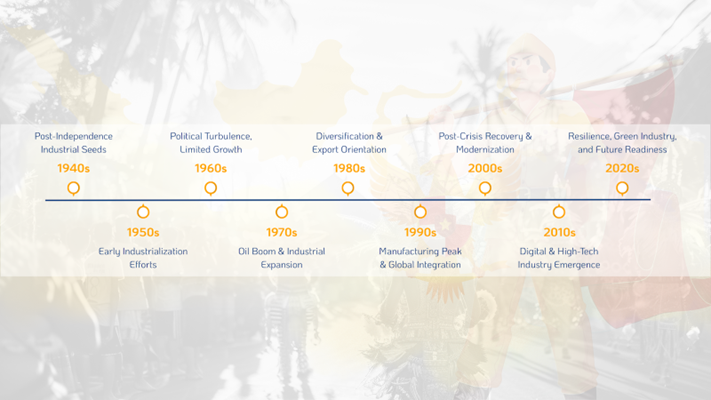
Indonesia’s industrial journey began modestly. In the early 1960s, manufacturing contributed less than 10% of GDP, with the government focusing mainly on rebuilding colonial-era infrastructure.
During the New Order era, policies shifted decisively toward industrialization and export orientation. By 1997, manufacturing contributed 25% of GDP, with more than half of exports coming from manufactured goods—fueled by deregulation, infrastructure development, and capital accumulation.
The oil crisis of the 1980s pushed further reforms, driving the growth of labor-intensive industries such as textiles, footwear, and electronics. By the late 20th century, Indonesia had become a competitive global production hub.
The post-1998 reform era brought new challenges and opportunities—economic liberalization, technology adoption, and global market diversification—compelling industries to adapt and compete internationally.
Industry as a Modern Economic Pillar
Today, manufacturing remains a vital pillar of Indonesia’s economy. In 2024, the sector contributed 18.5% of GDP and employed around 18 million workers (14% of the labor force). Other estimates put the figure above 21 million, making it the third-largest employer after agriculture and automotive services.
Key subsectors include food and beverages (32% of manufacturing GDP), basic metals (9%), textiles (7%), and automotive components (6%). Food and beverages, in particular, continue to grow steadily despite global economic volatility.
The Numbers Behind the Progress
In 2024, manufacturing’s contribution to GDP reached 18.98%—higher than the global average of 15.3% and surpassing countries such as India, Italy, Brazil, and Germany.
The sector also attracted IDR 721.3 trillion in investment, accounting for 42.1% of total national investment. The Manufacturing PMI has consistently stayed above 51.0 since 2024, signaling continued expansion.
Despite headwinds—such as a 6.95% year-on-year decline in FDI in Q2 2025—total investment still created over 665,000 new jobs. Indonesia’s economy grew by 5.1% in Q2 2025, showing resilience amid slowing household consumption and middle-class pressures.
Batam: A Regional Industrial Success Story
Batam exemplifies how regional industrial hubs can accelerate national growth. Strategically located near Singapore, Batam has developed into a base for electronics, shipbuilding, and medium-to-high technology manufacturing.
In 2025, BP Batam set an investment target of IDR 60 trillion. By mid-year, realized investment reached IDR 33.72 trillion, or 56.2% of the target—an increase of nearly 65% compared to the same period in 2024. This momentum aligns with Indonesia’s industrialization agenda and demonstrates the power of regional hubs to drive national progress.
Downstreaming as an Economic Strategy
A cornerstone of Indonesia’s industrial policy is downstream processing. Nowhere is this clearer than in nickel: exports of processed nickel products surged from USD 1.4 billion in 2014 to nearly USD 61 billion in 2024, making Indonesia the world’s leading player.
Policies such as the 2020 Mineral and Coal Law and domestic processing requirements have spurred the development of integrated industrial zones in Morowali and Weda Bay, creating jobs and regional growth.
These efforts align with the Making Indonesia 4.0 roadmap and the Digital Industry Center (PIDI 4.0), aimed at technology adoption, workforce upskilling, and SME competitiveness in global markets.
Looking Ahead
Strengthening Indonesia’s industrial base is not just an economic agenda—it is a long-term national strategy.
In Batam, strategic industrial zones play a vital role. Among them, Tunas Prima Industrial Estate stands out as a catalyst for growth, offering world-class infrastructure, a strategic location near global trade routes, and facilities designed for efficient production and distribution.
With these advantages, Tunas Prima is not only an industrial hub but also a trusted business expansion partner for investors seeking growth opportunities in Indonesia. Through the synergy of competitive industrial zones and pro-industry policies, Indonesia is poised to secure its place as a resilient economic power on the global stage.