

23 Jan
Indonesia 2026: The Aggressive Pivot
From Policy Signals to Enforcement Reality
Indonesia has entered a new industrial phase. The 2024–2025 regulatory cycle marks a clear transition from policy intention to enforcement. Licensing is now selective, incentives are targeted, and compliance is non-negotiable. The government is intentionally raising entry barriers to accelerate the shift from extraction and low-value manufacturing toward high-value, technology-driven, and export-oriented industries. For investors, the question is no longer whether Indonesia is attractive.
The question is where execution is most reliable.
The 2026 Industrial Direction
Nickel and Critical Minerals: Value Must Stay Onshore
Indonesia’s nickel strategy now prioritizes downstream integration. Mining permits are tied to processing, and policy clearly favors battery materials, precursors, and EV supply chains over raw exports.
This positions Indonesia as a global EV and battery hub, not a commodity supplier. Investors aligned with integrated processing, HPAL technology, and battery manufacturing are structurally advantaged.
Energy and Renewables: Net Zero Becomes Cost Variable
With coal restrictions and active carbon pricing, energy is now an operational and financial consideration. Industrial users increasingly require certifiable renewable power to maintain export access and cost competitiveness.
Indonesia’s energy transition has moved into execution and monetization, creating demand for captive renewables, storage, and carbon-aligned industrial estates.
Manufacturing: Selective, Not Mass-Market
Indonesia is no longer competing as a low-cost assembly base. Licensing and incentives now prioritize:
- High-tech manufacturing
- Automation and Industry 4.0
- Low-carbon, export-ready production
This marks a realignment of FDI toward precision and capability, not labor arbitrage.
Digital Infrastructure: Regulation Drives Physical Demand
Data protection enforcement and sector prioritization are driving real investment into data centers, smart infrastructure, and compliant digital facilities. Digital growth in Indonesia now requires physical, energy-secure assets.
Why Batam Is the Strategic Industrial Platform
Batam combines regulatory alignment, logistics efficiency, and regional access.
Batam is where Indonesia’s industrial pivot is already operational that offers:
- Proximity to Singapore and international trade routes
- Established industrial corridors and ports
- Special Economic Zones (KEK) for high-value industries
- Renewable energy potential and cross-border connectivity
Batam functions as:
- A downstream coordination hub for EV and battery industries
- A green energy gateway for regional markets
- A high-tech manufacturing base aligned with new licensing priorities
- A compliant digital infrastructure location under national regulations
Tunas Prima Industrial Estate: Built for Execution
In an enforcement-driven environment, industrial estates must deliver more than land.
Tunas Prima Industrial Estate (TPIE) is a 100-hectare green industrial estate developed by Tunas Group, located in Kabil, one of Batam’s most active and established industrial zones. TPIE is designed to support export-oriented, technology-driven manufacturers seeking operational certainty and long-term efficiency.
Strategic Accessibility
- Hang Nadim International Airport: 5 minutes
- Nongsapura Ferry Terminal: 10 minutes
- Batam Center Ferry Terminal: 15 minutes
- Batu Ampar Container Port: 30 minutes
Operational Infrastructure
- 100% renewable energy supply, in partnership with PLN
- Secure water management with alternative sources
- Green Mark–certified infrastructure and smart estate planning
- Wide internal roads and stable utilities
- Integrated fire safety and premium power services
One-Stop Business Solutions
TPIE provides an integrated development and operational platform:
- Feasibility study and site planning
- Facility design and construction
- Built-to-suit development
- Standard Factory Buildings (SFB) from 640 m² to 3,220 m²+
- Industrial land sales and custom development options
Available factory typologies support scalable manufacturing, from precision assembly to large-format industrial operations.
A Thriving Manufacturing Ecosystem
TPIE is home to national and international manufacturers aligned with downstream and technology-oriented industries. Their presence reflects confidence in TPIE’s infrastructure, reliability, and execution capability, including:
- PT Solder Tin Andalan Indonesia
- Haitai Solar
- PT Luxsan Precision Indonesia (Luxshare ICT)
- CLOU Midea Electronic
- PT STGM Industri Manufaktur (Zhengte)
- Professional Testing Services (PTS)
- PT CEME Fluid Solutions
- And many more…
Choosing the Right Platform in Indonesia 2026
Indonesia’s aggressive pivot is already in motion. The advantage lies with investors who align early—with the right location and the right partner. Batam offers connectivity, compliance, and regional access. Tunas Prima Industrial Estate delivers a practical, integrated platform for industrial execution. For companies focused on long-term operations, regulatory certainty, and export competitiveness, TPIE is positioned to support the next phase of industrial growth in Indonesia.
19 Jan
Nickel Outlook Indonesia 2026
Nickel on Rise: From Market Control to Downstream Advantage
In 2026, Indonesia’s nickel industry enters a decisive phase. What began as a strategy of scale is now evolving into one of discipline, integration, and long-term value creation. As the world’s largest nickel producer, Indonesia is no longer merely responding to global demand—increasingly shaping the structure of the market itself.
This transition is anchored in a clear policy reset: tightening upstream supply while accelerating downstream value creation, positioning Indonesia as a strategic backbone of the global battery and clean energy supply chain.
1. Recalibrating Supply: From Volume to Control
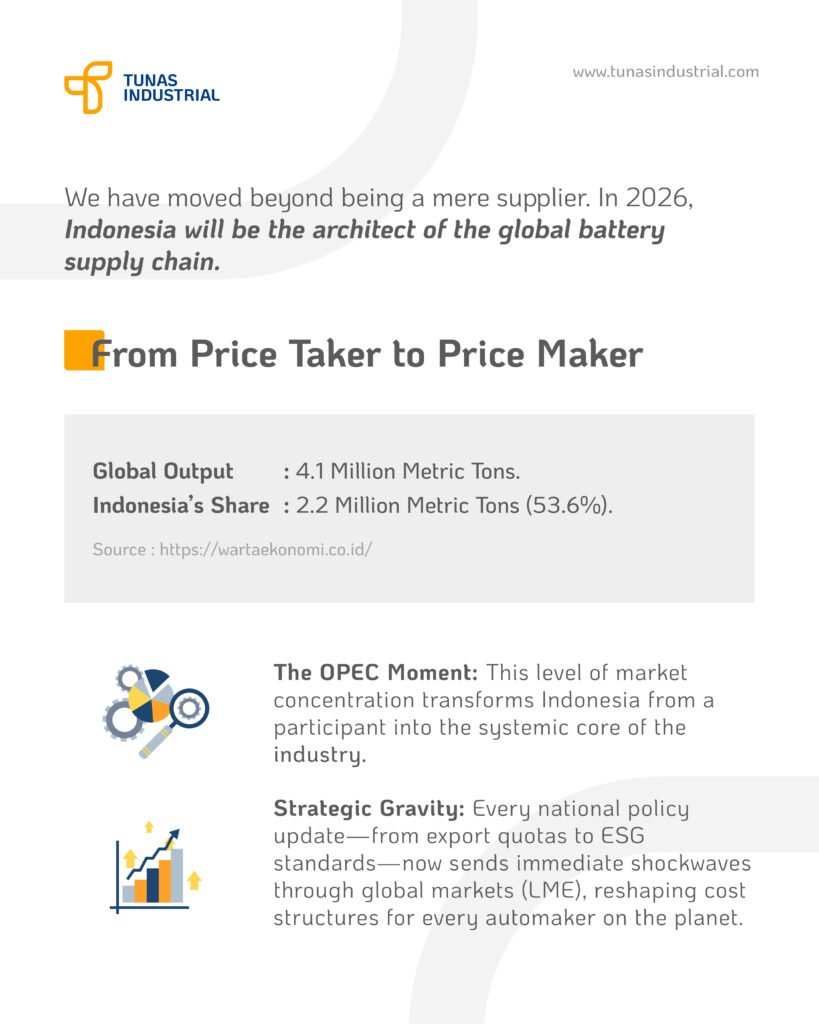
Indonesia plans to reduce raw nickel ore production in 2026 from approximately 379 million tonnes in 2025 to around 250 million tonnes. The objective is to manage global oversupply, stabilize pricing, and rebalance industry incentives. Given Indonesia’s dominant share of global nickel output, even partial implementation sends immediate signals across international markets—marking a structural shift from price taker to market shaper.
2. Price Discipline and Market Volatility
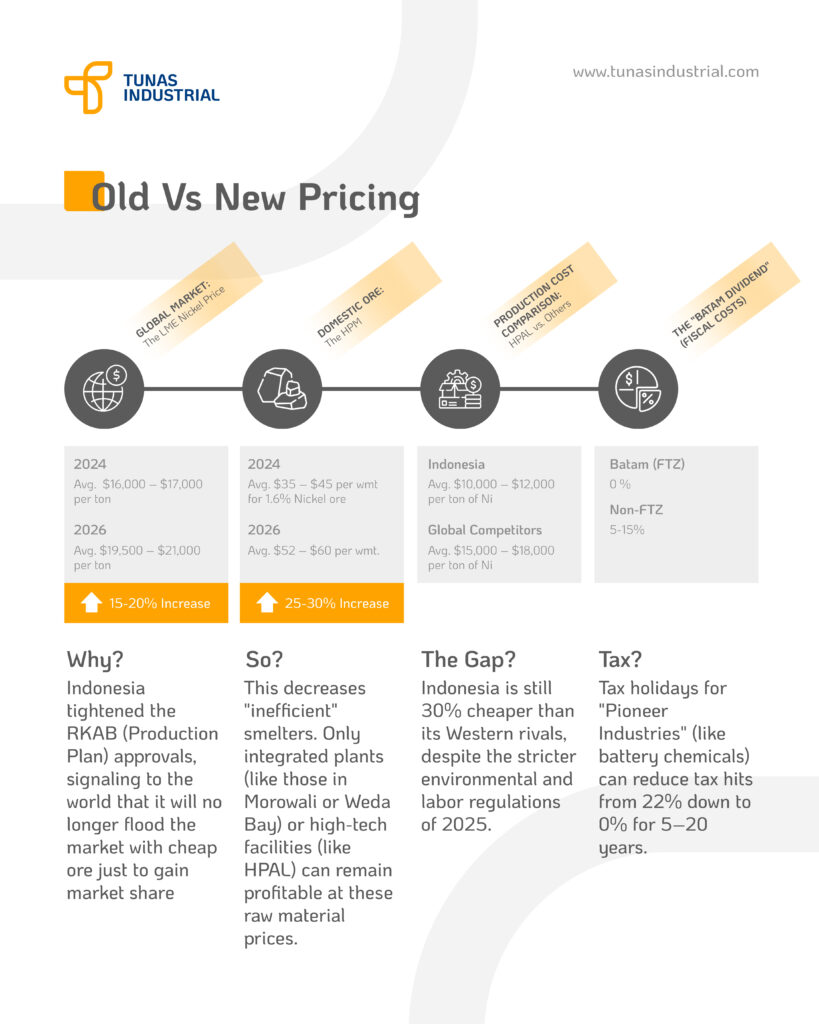
Production control is designed to support nickel prices after years of compression. Still, 2026 is expected to remain volatile, shaped by regulatory enforcement, miner compliance, and global demand dynamics. In this environment, competitiveness is no longer driven by volume alone, but by cost efficiency, integration depth, and location within the value chain.
3. Downstream Integration as Strategic Core
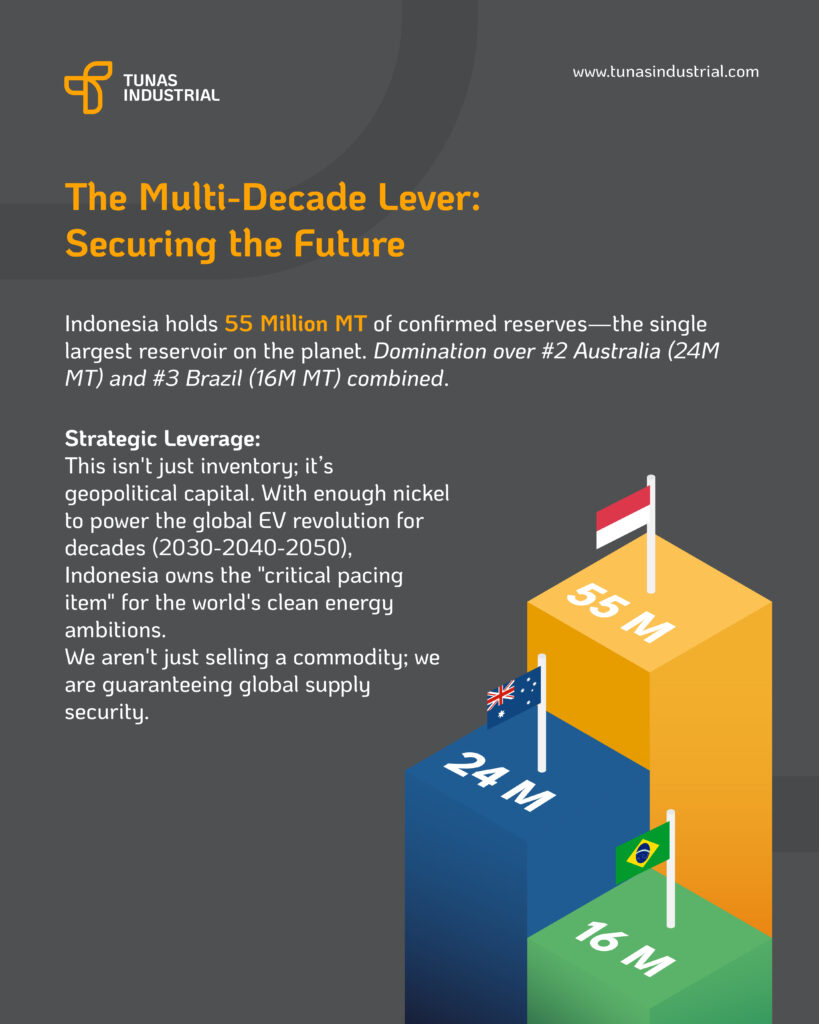
Beyond supply discipline, Indonesia’s primary objective is value capture. Policy focus continues shifting toward battery-grade nickel products such as:
- Mixed Hydroxide Precipitate (MHP)
- Nickel sulphate
- Cathode precursor materials
Despite growing adoption of LFP batteries, nickel-intensive chemistries remain critical for long-range EVs and energy storage solutions. Long-term EV demand growth toward 2030 continues to underpin structural nickel demand. Indonesia is no longer exporting ore—it is embedding itself into global EV, battery, and energy storage ecosystems.
4. Regulatory Tightening Reshapes Competitive Advantage
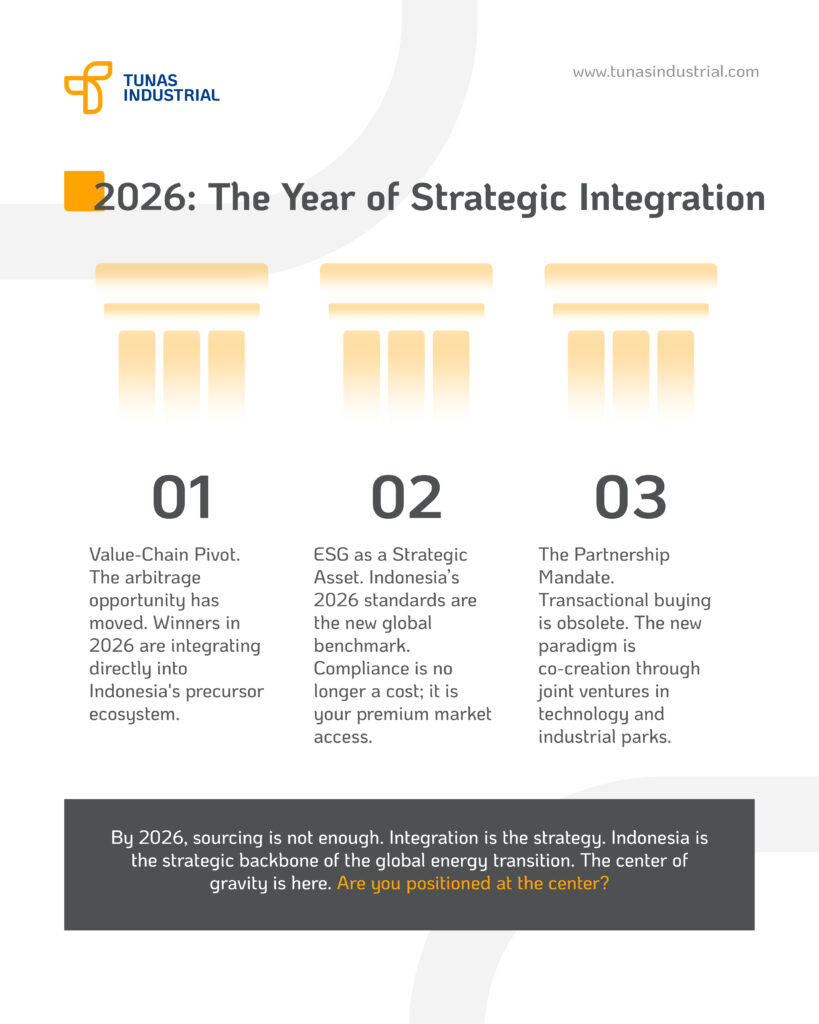
Stricter RKAB approvals, tighter environmental governance—particularly for HPAL operations—and higher compliance standards are reshaping industry economics. Lower-efficiency operators face margin pressure, while integrated and compliant players gain a durable edge. As a result, capital increasingly gravitates toward locations that minimize regulatory friction while maintaining export efficiency.
5. Batam: The Downstream Industrial Hub
As upstream nickel production becomes more disciplined, downstream flexibility and efficiency become decisive. In this context, Batam emerges as a strategic downstream hub where processing, component manufacturing, and export converge.
Batam’s advantages include:
- Free Trade Zone (FTZ) status, enabling 0% import duties
- Proximity to Singapore’s logistics, finance, and certification ecosystem
- Export-oriented infrastructure and regulatory efficiency
This positioning is reinforced by an existing base of export-oriented manufacturers in electronics, energy, precision engineering, and industrial services—demonstrating Batam’s readiness for advanced downstream industries.
6. Tunas Prima: Translating Strategy into Industrial Readiness
Within Batam, Tunas Prima Industrial Estate (TPIE) functions as an execution platform for downstream industrialization aligned with Indonesia’s nickel strategy. Designed to support advanced manufacturing and energy-related industries, Tunas Prima offers:
- A masterplanned industrial environment with scalable land availability
- Infrastructure suited for high-spec, export-driven operations
- Alignment with green industry principles and sustainability standards
With established international manufacturers such as Luxshare ICT and CLOU Electronics—whose their first Battery Energy Storage System (BESS) manufacturing in Indonesia—Tunas Prima demonstrates operational readiness as an industrial ecosystem capable of accommodating and scaling downstream industries, including nickel-related investments.
Conclusion
Indonesia’s nickel outlook in 2026 is no longer defined by how much it produces, but by where and how value is completed. As upstream supply becomes more disciplined, downstream execution becomes the differentiator. Batam represents the logical convergence point for export-oriented value creation—while Tunas Prima provides the industrial readiness that translates national policy into global supply chain participation. Connect with us now.